绿灯侠
GT Voice: Chinese investment could help Germany stabilize its talent base_我的网站

一 |
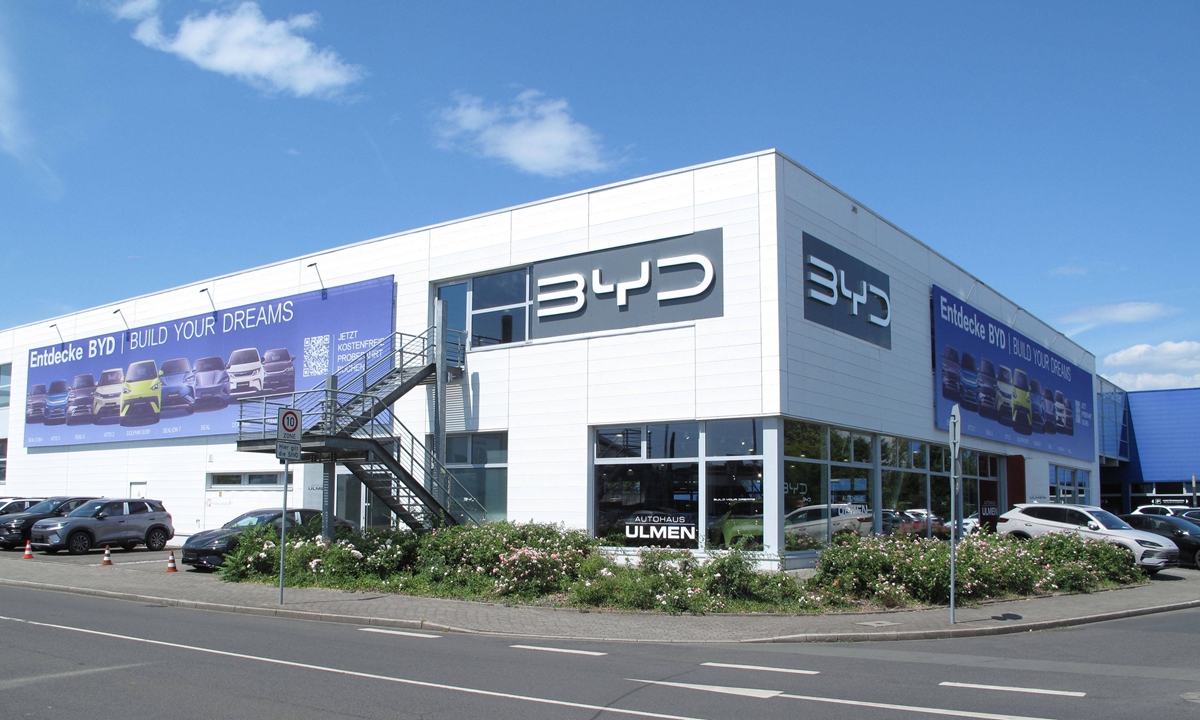
A BYD flagship store at the Ulmen car dealership on H?herweg Auto Mile in Düsseldorf, Germany, with new cars on display out front. Photo: VCG
Germany's industrial woes have increasingly become a hot topic of discussion. The latest Engineer Monitor report from professional association Verein Deutscher Ingenieure and the German Economic Institute offers a new look at the issue.
The report showed that there were 58,392 unemployed individuals in the engineering and information technology (IT) professions in the fourth quarter of 2025, the highest level since the survey began in 2011.
Compared with the previous year, the number of unemployed increased by 16.7 percent, according to German media reports on Sunday.
These figures lay bare the challenges confronting the country's manufacturing sector. The reasons for the industrial woes are multiple. The soaring energy costs caused by geopolitical conflicts, the decline in exports caused by rising protectionism and low external demand, and the structural pain caused by industrial chain restructuring are all squeezing the space of German manufacturing.
Manufacturing is the backbone of Germany's economy, and engineers and IT specialists constitute the core force that sustains this pillar. For decades, the country's reputation for "Made in Germany" excellence was built on the expertise of these skilled professionals. Regardless of the macroeconomic ups and downs, preserving the stability and continuity of its industrial talent pool represents a strategic bottom line for Germany.
Should large numbers of highly skilled technical professionals leave the industry or sit idle, industrial research and development (R&D) and production cycles will be disrupted. Over the longer term, such a waste of human capital will erode Germany's industrial innovation capacity and, ultimately, undermine the foundations of its global competitiveness.
In this context, the urgent task for Germany is to create sufficient quality positions for its technical talent. Should it fail to do so in the short term, then Germany needs to embrace a more open‑minded development approach. Shoring up its manufacturing base cannot be achieved solely through protecting domestic companies; it also requires a significant expansion of effective investment to create enough high‑quality jobs that can attract and retain skilled talent.
This is exactly where China‑Germany cooperation could deliver tangible results. According to the FDI Report 2025 published by Germany Trade & Invest (GTAI), the total number of foreign investment projects in Germany fell 9.3 percent overall to 1,564 in 2025. Nonetheless, Chinese companies became the largest source of foreign investment projects in Germany in 2025, overtaking the US for the first time since 2017.
Chinese companies launched 228 investment projects in Germany in 2025, up 14.6 percent year-on-year. More than one in five Chinese investment projects involved production and R&D activities, above the overall average for foreign investment projects in Germany. This is a sign that Chinese firms are deepening their integration into the local industrial base, according to GTAI.
Observers noted the trend, pointing out that China is becoming an important force in driving German re‑industrialization. In industries where Germany urgently needs to rebuild its competitive edge, such as electric vehicles, batteries, energy technology, digital manufacturing, and automation, China is emerging as an increasingly significant complementary partner. In these critical areas that will determine industrial competitiveness in the coming decades, the relationship between China and Germany is not merely one of rivalry; there are clear and substantial complementarities. Germany still boasts world‑leading engineering expertise, precision manufacturing capabilities, and a strategic location at the heart of the European market.
China has complete and highly integrated supply chains for raw materials and intermediate goods and large capacity for increasing production. When Chinese automakers set up R&D centers in Germany, or when Chinese tech firms collaborate with German factories to build smart production lines, the beneficiaries are not only the Chinese companies but also the German engineers who would otherwise face redundancy.
Cross‑border investment cannot flourish without a sound policy environment. Chinese companies are apparently willing to develop in Germany, but it can only happen on the premise that the German side provides a fair, reasonable and predictable business environment, reduces non-market interference in commercial activities, and allows capital to operate in accordance with market rules.
If the two countries are able to reach a deeper level of cooperation in investment, many of Germany's trade‑related concerns may well find more pragmatic solutions. The deep integration of industrial value chains would facilitate two‑way trade, creating renewed momentum for German exports of machinery, vehicles, chemicals, and other competitive products to China.
。
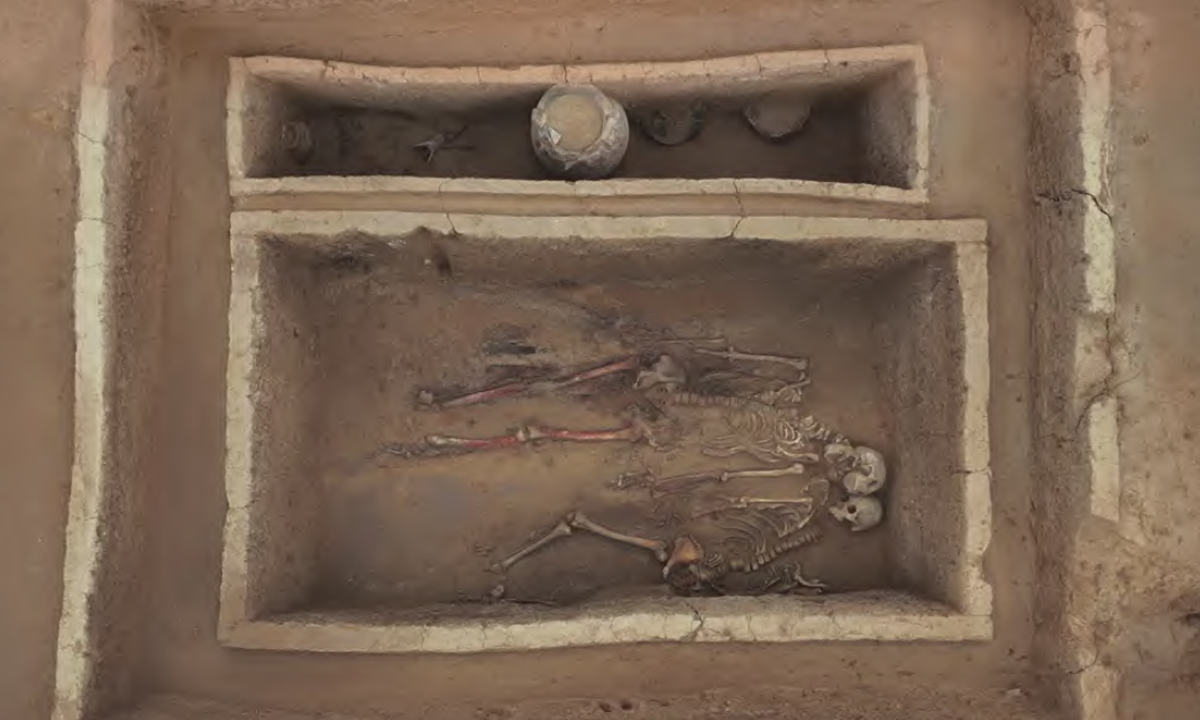
Coffin chamber M13 Photo: Courtesy of the Shanxi Provincial Institute of ArchaeologyThe highest-ranking noble cemetery complex from the late Xia Dynasty (c.2070BC-c.1600BC) ever discovered has been unearthed at the Zhongcun site in North China's Shanxi Province, expanding research on Xia and Shang (c.1600BC-1046BC) civilizations and early state formation in ancient China, according to a press release that the local institute of archaeology sent to the Global Times on Monday.
Located on a hilly terrace west of the Taihang Mountains and flanked by the Songxi River, the site was excavated in 2024 and 2025 by the Shanxi Provincial Institute of Archaeology and partner institutions, leading to the discovery of 18 tombs, including six Xia Dynasty burial sites and 12 Warring States Period (475BC-221BC) graves.
"These are the highest-ranking Xia aristocratic tombs discovered so far, indicating that this location was a regional center," the institute said.
The Xia Dynasty is traditionally regarded as China's first hereditary dynasty, though contemporaneous written records are lacking.
The well-organized Xia tombs, concentrated in the western part of the cemetery, feature uniform east-west oriented vertical earthen pits. Researchers recovered nearly 40 sets of artifacts with distinctive local cultural characteristics, including pottery, lacquerware and turquoise ornaments.
Extended regional surveys across the Songxi River valley yielded more than 10 Xia and Shang period sites. Test excavations at nearby relic sites unearthed pottery fragments, stone tools, bronze knives, as well as tin-bronze ingots and smelting residue, providing solid evidence of early metal mining and craftsmanship.
Local copper-iron symbiotic ore deposits confirm exploitation of these resources during the Xia and Shang eras, while typical cultural artifacts found in adjacent counties reveal widespread regional cultural exchange.
Multidisciplinary analyses further decoded the civilization's features. Ancient human remains belong primarily to the ancient population of the Central Plains with minor Mongolian Plateau genetic traits, forming a stable patrilineal clan. The community relied on millet farming and maintained long-distance resource trade networks.
Artifact provenance tests trace scallop shell ornaments to the Bohai Sea, cinnabar to Hunan-Guizhou ore belts, turquoise to the eastern Qinling Mountains area, and coffin timber to local Taihang pine trees. Such diverse materials reflect close interaction among the Taihang foothills, the press release noted.
Lab restoration unveiled refined ritual relics, including a dragon-patterned lacquer cylinder with red and black stripes and an intact lacquer gu vessel (a type of wine vessel). Turquoise plaques from the site match specimens from the Erlitou site, a core Xia cultural relic, proving cross-regional cultural interaction. Radiocarbon dating places the site's active period between 1880BC and 1450BC, aligning with the late Xia Dynasty.
Scholars confirmed the findings have helped reshape academic understanding of Xia-Shang civilizations and reconstruct multi-level settlement patterns on the western Taihang foothills, while offering new insights into social complexity and civilization development in early China.
。
Current article:http://6tj3gil.shouyouxumianpouluanteng.shop/8wfo2s/6jzr.html
Published on:06:31:21
